Buzzy Party: Mimic Voice
- 4.7
- Rating
- 500.00K
- Installs
- Free
- Price
 Analysis by App-foxy
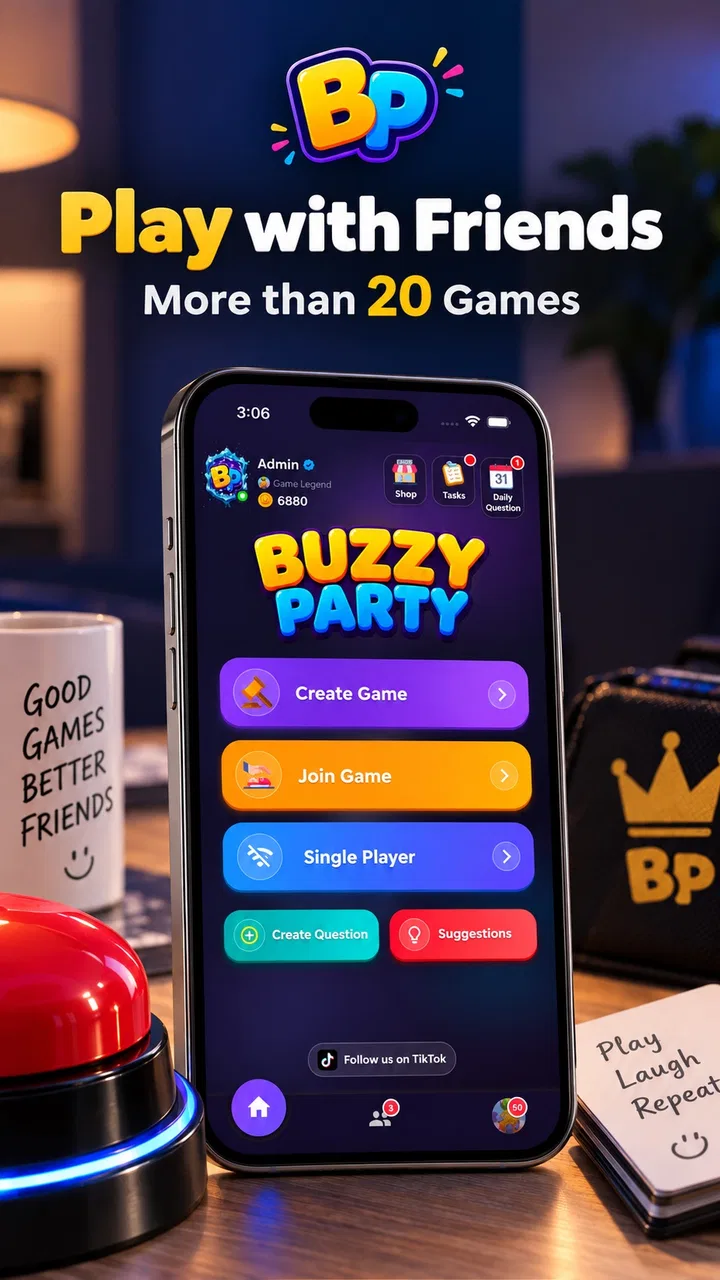
I tried Buzzy Party: Imposter & Games as the kind of trivia title that makes more sense with people nearby than during a quiet solo session. It is a free multiplayer party game from Buzzy Party, built around quick questions, buzzer-style reactions, and the playful tension of figuring out who fits a prompt. That combination gives it a very different feel from a traditional trivia app: the entertainment comes not only from knowing the answer, but also from reacting quickly, watching friends hesitate, and turning small mistakes into conversation.
That social focus is the main reason I would recommend it. If you want a serious knowledge test with a carefully structured solo campaign, this is probably not the first game I would choose. If you need something easy to explain at a gathering, though, it has a much more approachable starting point. The game is rated for Everyone, so it is suitable for a broad group, and its store presence shows a 4.7 average from around 2.6 thousand ratings. Those figures suggest that the quick party format is connecting with players, but the real question is whether the pacing works for your particular group.
How the first few rounds create a reason to keep playing
The early goal is simple: understand the rhythm, answer when you can, and enjoy the reactions around the room. That simplicity is useful because nobody needs a long tutorial before joining in. A new player can watch one short exchange, understand that timing and recognition matter, and start participating. For a party game, that low entry barrier is more valuable than a large collection of complicated rules.
You May Also Like

 Blood Strike: 2.5 Anniversary
Blood Strike’s Loadouts Turn Every Drop Into a Tactical Gamble
A close look at Blood Strike’s custom loadouts: how fast access to signature weapons reshapes its battle royale rhythm, rewards preparation, and narrows the gap between fights.

 Pandora - Music & Podcasts
Pandora’s Music Is Easy to Start, but Harder to Recover
Pandora’s strength is its low-effort path from a seed to a station. Its weak spot is how much confidence it asks you to place in connection, setup, and quiet recovery.

 8 Ball Pool
 Is Built on Rivalries, Rematches, and Routine
A close look at the rivalries, rematches, shared routines, and unanswered safety questions that turn a quick pool match into a persistent mobile community.

 Samsung Music
’s Quiet Strength Is Playing What You Already Own
Its reach comes less from spectacle than from dependable access to a personal library. That simplicity is both the app’s strongest retention engine and its ceiling.

 AccuWeather: Weather Radar
AccuWeather Review: A Quick, Clear Forecast for Everyday Decisions
For everyday plans, the best forecast is the one you can understand quickly. AccuWeather makes rain timing, radar, and local conditions easy to act on, with a few trade-offs.

 Hill Climb Racing
Why Hill Climb Racing Still Turns Crashes Into One More Run
A tiny car, a bumpy hill and one more upgrade: Hill Climb Racing keeps resurfacing because its simple chaos makes every near-miss feel personal.
More From Our News Desk
View All News


I also like that the basic loop gives players an immediate social objective. You are not merely trying to increase a private score; you are trying to prove that you know the answer, catch someone out, or make a confident guess before another player does. In a group of friends, those small moments become the early motivation to play another round. Someone who missed a question usually has an obvious reason to try again, while someone who succeeded has a reason to defend that reputation.
The “Who Am I?” flavor adds another layer to the opening minutes. It encourages players to think about clues and identity rather than treating every prompt as a dry fact-checking exercise. That helps the game feel more like a conversation with rules than a school quiz. I found this especially useful when playing with people who normally lose interest in conventional trivia because they do not want to sit through a long sequence of formal questions.
One practical tip is to begin with a group that is comfortable speaking up. Buzzer-style play can favor the person who reacts fastest, and quieter players may need a little encouragement before the room settles into a fair rhythm. I would avoid presenting the first session as a test of intelligence. Treating it as a warm-up makes mistakes less awkward and gives everyone time to understand how aggressively they want to compete.
The game is free to download, which makes that first experiment easy. There are in-app purchases ranging from 49 cents to $9.99 per item, so I would decide in advance whether the free experience is enough for your group rather than letting a party session turn into an unplanned spending decision. The important point is that the initial appeal does not depend on a complicated setup: install it, gather players, and see whether your group enjoys fast trivia with a social twist.
What counts as progress when the game is built around people
In a conventional trivia game, progress is often visible through levels, badges, stages, or a growing personal record. Here, the more meaningful progress signals are likely to come from the group itself: players become quicker at recognizing the type of prompt, better at judging when to commit, and more confident about challenging a friend’s answer. I would not measure the experience only by whether one person wins repeatedly. The stronger sign is whether the group becomes more engaged from round to round.
That makes the game particularly suitable for short gatherings. You can use it as a ten-minute icebreaker, return to it between other activities, or make it the central activity for a relaxed evening. It does not require the same commitment as a long campaign, and that is a strength when your audience includes people who are unsure about mobile games. They can participate briefly without feeling that they have signed up for a major progression system.
There is also a useful distinction between individual improvement and group improvement. An experienced player may become faster and more accurate, but the group’s enjoyment can improve even when the score gap does not. Friends learn each other’s habits: who answers too early, who waits for a safer clue, and who becomes unusually confident when a familiar subject appears. Those personal patterns are not a substitute for formal unlocks, but they create a kind of social progression that suits a party title.
My advice is to rotate the role of organizer instead of letting the same person control every session. A different host can change the energy of the room, help new players feel included, and prevent the game from becoming a contest between the two fastest responders. This is one of the less obvious ways to get more value from Buzzy Party: the app supplies the structure, but the people around it determine whether the structure feels welcoming or repetitive.
It is also worth setting a clear stopping point. Because the rounds are easy to start, a group can continue after the energy has peaked. Ending while people are still laughing is better than forcing another session after everyone has begun looking at their phones. For me, that is a sign that the game works best as a flexible party tool rather than as a title that must carry an entire evening by itself.
Challenge and the shape of the difficulty curve
The challenge in this format is not limited to factual knowledge. You are balancing recognition, timing, confidence, and the risk of being wrong in front of friends. A player who knows the answer but waits too long may lose the moment, while a player who guesses quickly can win through nerve. That creates a more human difficulty curve than a simple sequence from easy questions to hard questions.
For mixed groups, this is both helpful and potentially frustrating. A strong trivia player may dominate if the same people always react first. On the other hand, someone with less general knowledge can still have good rounds by reading the situation well and acting decisively. I appreciate that the social layer gives less experienced players a way to compete, but I would not pretend it removes the advantage of speed and confidence.
The best way to manage that trade-off is to change the atmosphere rather than invent house rules that undermine the game. Encourage players to explain an answer after the moment has passed, celebrate clever guesses, and avoid turning every mistake into a personal challenge. If your group enjoys loud competition, the pressure can be hilarious. If your group includes children or easily embarrassed players, a gentler tone will produce a better experience than demanding that everyone buzz in instantly.
The Everyone age rating supports the idea of a broad audience, but age suitability does not automatically guarantee that every group will enjoy the same level of intensity. Younger players may need extra time to understand the flow, while adults who already know one another’s strengths may make the competition much sharper. I would introduce it differently for a family gathering than for a late-night friends’ game: in the first case, focus on participation; in the second, let the rivalry become part of the entertainment.
Compared with a standard multiple-choice trivia app, Buzzy Party feels less controlled and more dependent on the room. A solo quiz is usually better when you want to learn, practice, or steadily improve a personal score. A board-game-style trivia session may be better when you want a longer, more deliberate contest with physical components and a fixed structure. This game sits between those options: it offers the convenience of a phone while trying to preserve the immediacy of a buzzer party.
That comparison also explains its main weakness. If nobody is willing to react, talk, or tease one another lightly, the central appeal loses strength. The app cannot create group chemistry on its own. It can give a quiet gathering a prompt, but it cannot replace the energy of players who are ready to participate. I would choose a conventional quiz for a solo commute and save this one for a setting where at least a few people want to interact.
Does the pacing create healthy retention or pressure?
The pacing is designed around quick engagement rather than a slow climb through a large personal journey. That makes returning easy because the cost of another session is low. You do not need to remember a complicated campaign state to enjoy a new party. The natural retention hook is the unfinished rivalry: a player who lost narrowly wants another chance, while the winner wants to prove the first result was not luck.
That kind of retention feels healthier to me than being pushed through a long checklist. You return because the group is available and the last round created a story, not simply because a progress bar demands attention. Still, it can become repetitive if the same people use the same competitive habits every time. The solution is to vary the social context—play with a different mix of friends, bring it out during a family visit, or use it as a short break rather than repeating a full session immediately.
The purchase range deserves a little attention here. Optional spending can be reasonable when it adds convenience or variety, but I would not assume that buying an item will solve a group that is already losing interest. First identify what your players enjoy: the clues, the speed, the guessing, or the banter. If the problem is that nobody likes the format, extra content will not change that. If the group is already engaged and wants to extend the experience, an in-app purchase may feel more justified.
Another useful habit is to keep the phone visible and pass responsibility around. When one person holds the device for too long, everyone else can start feeling like an audience instead of a player. A party game works better when the app remains a shared tool. This is a small organizational detail, but it has a direct effect on retention: people are more likely to play again when they remember being involved rather than waiting for someone else to finish.
The current version is 1.7.62, and the game supports Android 7.0 or later. For someone deciding whether an older Android device can run it, that minimum requirement is worth checking before planning a group session. I would also install and open it before guests arrive, especially if the phone is being used as the central screen. A few minutes of preparation can prevent the least entertaining kind of party pause: everyone waiting while the host troubleshoots.
Who should choose it, and who should skip it?
I would recommend Buzzy Party to friends who want a lightweight multiplayer trivia game that can start quickly and create conversation. It is a good fit for casual gatherings, family occasions where a broad age rating matters, and groups that enjoy playful competition more than formal scoring. The combination of trivia and identity-based guessing gives it enough personality to stand apart from a plain question-and-answer app.
I would be more cautious about recommending it to someone seeking a deep solo experience. If your main goal is to build knowledge, track long-term improvement, or play without speaking to anyone, a dedicated quiz trainer will probably serve you better. The same is true if your group dislikes fast reactions or feels uncomfortable with public mistakes. The game’s charm depends on participation, and that dependence is not a flaw for a party title, but it is a real limitation for the wrong audience.
It may also be a weaker choice for a group that wants a highly balanced contest between players with very different ages or knowledge levels. You can soften the difference with a friendly atmosphere and by giving newcomers room to learn the rhythm, but the fastest and most confident participants may still have an advantage. In that situation, a turn-based trivia board game or a slower quiz app could feel fairer.
For a realistic everyday use case, I can imagine bringing it out after dinner when several friends are together but nobody wants to commit to a full board game. One person opens the app, explains that the aim is to react to prompts and identify the right answer or person, and the first round becomes a test of the group’s energy. If everyone starts commenting on who answered too soon and who clearly knew the clue, the game has done its job. If the room stays silent, I would switch to another activity rather than forcing it.
My progression verdict
As a trivia party game, Buzzy Party understands that progress does not always need to look like a long list of unlocks. Its early goals are clear, its improvement signals come from quicker recognition and stronger group chemistry, and its difficulty comes from the tension between knowing and acting. That is enough to sustain repeat sessions when the players themselves provide the variety.
Its retention is therefore situational rather than universal. I can see it becoming a favorite in a friend group that enjoys rematches and playful arguments, while a solo player may exhaust the appeal much sooner. The free entry point makes it easy to test, and the broad age rating makes it convenient for mixed gatherings. At the same time, the in-app purchase range means I would try the basic experience first and spend only if the group has already shown that it wants more.
Buzzy Party has reached over 500 thousand installs, and the developer behind it is Buzzy Party. Those details fit the impression I get from the game: it is designed to be picked up quickly and shared rather than treated as a private, long-form hobby. I would keep it installed for spontaneous gatherings, but I would not replace a serious trivia app or a substantial tabletop game with it.
My final recommendation is straightforward: choose it when the people matter as much as the questions. The strongest moments come from quick guesses, surprised reactions, and the friendly pressure of trying to beat someone who thinks they are unbeatable. Its real progression is the group learning how to play together, and that can be genuinely satisfying. Just make sure your audience wants a lively multiplayer session, because without that social spark, the game has less room to show what makes it distinctive.
FAQs for Buzzy Party: Mimic Voice
01What is Buzzy Party: Imposter & Games?
Buzzy Party: Imposter & Games is a multiplayer party game available on Android and iOS. It combines classic party games with a unique imposter twist. Players can enjoy a variety of mini-games while trying to identify the imposter among them. It’s designed for both casual and competitive play, making it perfect for gatherings.
02How do I play Buzzy Party: Imposter & Games?
Once you download the app, you can either join a game with friends or play with random players online. The game includes various mini-games and challenges. Players work together to complete tasks, but one or more imposters try to sabotage the efforts. Your goal is to complete tasks or identify the imposters before they win.
03Is Buzzy Party: Imposter & Games free to download?
Yes, Buzzy Party: Imposter & Games is free to download on both Android and iOS platforms. However, it may contain in-app purchases and ads. These purchases typically offer additional features or cosmetic items, and ads can be removed with a premium version or subscription.
04What age group is Buzzy Party: Imposter & Games suitable for?
Buzzy Party: Imposter & Games is generally suitable for ages 10 and up. The game’s content is designed to be family-friendly, but it involves strategic thinking and social interaction, which may be challenging for younger children. Parental guidance is recommended to ensure age-appropriate play.
05Can I play Buzzy Party: Imposter & Games offline?
Buzzy Party: Imposter & Games primarily requires an internet connection to play, as it involves multiplayer interactions. However, some mini-games might be available in a solo mode offline, but the core imposter experience and full features are best enjoyed online with others.
Pros
- Engaging mini-games for all ages.
- Seamless multiplayer experience.
- Vibrant and fun graphics.
- Regular content updates keep it fresh.
- Easy to learn
- hard to master.
Cons
- Occasional in-app ad interruptions.
- Limited offline functionality.
- Some games may feel repetitive.
- In-app purchases can add up.
- Requires stable internet connection.

Buzzy Party: Mimic Voice
Gallery